
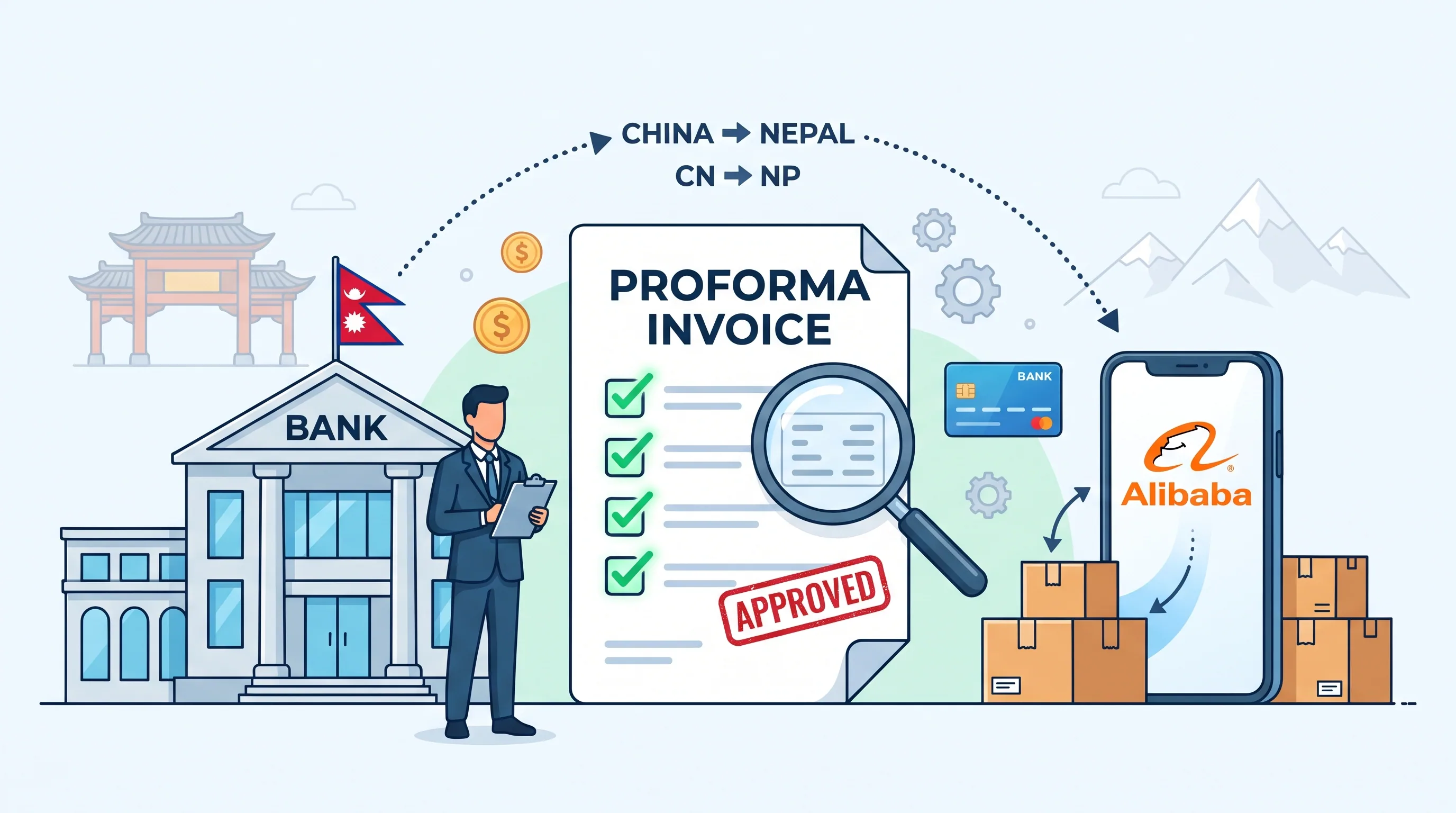
The exact 11 details a Nepali bank requires on a Proforma Invoice for an import TT to China. Based on direct experience with NIMB, including HS codes, EXW, and stamp rules.
Quick Answer: For a Proforma Invoice to be accepted by a Nepali bank for an import Telegraphic Transfer (TT), it must include 11 mandatory fields: the invoice number and date, supplier details, your company details, your EXIM code and PAN, a layman description of the goods, country of origin and shipping terms (Incoterm, ports, and Nepal customs entry point), the exact 8-digit HS code, unit rate and total amount (with domestic China delivery baked into the item price), supplier bank SWIFT details, TT payment terms, and stamps and signatures from both parties.
Once you find a supplier in China and agree on a purchase price for the goods you want to import, your very first official step is getting a Proforma Invoice from them. Without a bank-compliant Proforma Invoice, your Nepali bank will not initiate a Telegraphic Transfer (TT) to pay your supplier. This guide is a deep dive into Step 1 of our complete import walkthrough.
If you want to see how the entire 10-step process works from start to finish, read our main guide: How to Import Goods from China/Alibaba to Nepal: → The Bank TT Process, Step by Step (2026)
Let's first know what a Proforma Invoice even is:
As Investopedia outlines; A proforma invoice provides a preliminary invoice document that outlines the agreed terms and conditions of a sale, allowing buyers to understand their obligations before the official transaction. Basically, it is a document that you get from the supplier that mentions all the cost that would incur if you were to purchase from them, with per-item cost breakdown. Take it as a "Quotation" document before you decide to purchase.
This checklist is based on my direct, hands-on experience importing goods from China through Nepal Investment Mega Bank Limited (NIMB) in February 2026. Every requirement and rule below comes from what the bank actually checked on our paperwork.
(Note: Requirements may vary slightly depending on the bank you deal with or future policy updates, so always confirm with your branch).
TL;DR: The 11 Mandatory Items Your Proforma Invoice Must Have
Before submitting your Proforma Invoice to a Nepali bank, make sure your supplier has included every single item on this list:
1. Proforma Invoice number and date.
2. Beneficiary (supplier) name, address, contact number, and email.
3. Applicant (your company) name, address, contact number, and email.
4. Applicant's EXIM Code and PAN number.
5. Description of goods in simple, understandable layman terms.
6. Country of origin, Incoterm, Nepal Customs entry point, port of loading, and port of discharge.
7. Harmonized System (HS) code (exact 8-digit code as per the Nepal customs tariff).
8. Per-unit rate, quantity, currency, and total amount.
9. Beneficiary bank details: Bank name, bank address, account number or IBAN number, account
name, and SWIFT code.
10. Payment terms: 100% TT before shipment (or partial advance terms, if agreed accordingly).
11. Applicant and Beneficiary signatures and stamps on the Proforma Invoice.
Field-by-Field Breakdown: What Each Requirement Means
Suppliers in China deal with buyers worldwide, so their default invoice template often misses details that Nepali banks strictly enforce. Here is what each required field means and how to make sure it is mentioned properly:
| Information Required | What It Means & How Nepali Banks Check It |
|---|---|
| 1. Proforma Invoice no. and date | A unique reference number and the exact date the supplier issued the preliminary invoice. |
| 2. Beneficiary name, address, contact number and email | Beneficiary means the supplier or the manufacturer selling you the goods. Their full registered company name, physical address, phone number, and email must be listed. |
| 3. Applicant's name, address, contact number, and email | Your registered Nepali company's official name, address, phone number, email, and same details of your company representative who is dealing with the supplier. It should be mentioned under "Attn". |
| 4. Applicant's EXIM Code and PAN no. | Your company's Permanent Account Number (PAN) and your Export-Import (EXIM) Code, which is issued by the Department of Customs (usually at TIA). |
| 5. Description of goods in simple terms | Whatever you are importing, its description must be written in clear layman terms that a bank officer and customs officer can easily understand. |
| 6. Country of origin, Incoterm, Customs entry point, port of loading, and discharge | Country of origin: Where the product was made (in this case, China). Incoterm: The package handling agreement between you and the supplier (we used EXW). Customs entry point: Where your package will enter Nepal (such as Tribhuvan International Airport or Birgunj Customs). Port of loading and discharge: Usually the address of your freight forwarder's China warehouse or the port where they load your package. Confirm this exact address with your freight forwarder. |
| 7. Harmonic code (8-digit) as per customs tariff (exact) | The Harmonized System (HS) code is a universal numeric code assigned to product categories. You can ask your supplier to add it, or look up the exact 8-digit code on the Nepal National Single Window tariff search and give it to your supplier. |
| 8. Rate, Quantity, Currency, Total Amount | The per-unit price, total quantity of items, quoted currency (e.g., USD), and the final Total Amount. Keep in mind: Nepali banks will only wire the exact Total Amount in the quoted currency and will NOT pay for a separate delivery charge line item. |
| 9. Beneficiary Bank details | Your supplier's bank name, physical bank address, account name, account number (or IBAN), and SWIFT code, depending on what your supplier accepts and your Nepali bank supports. |
| 10. Payment Terms | Usually, Chinese suppliers accept 100% Telegraphic Transfer (TT) before they dispatch the product (or a split percentage in advance). Discuss this with your supplier beforehand, keeping in mind that each bank transfer incurs a Rs. 1,750 flat service fee. |
| 11. Applicant and Beneficiary signatures and stamps | The submitted Proforma Invoice must have stamps and signatures from both the supplier and your company. The supplier's stamp and signature can be digital, but your company's stamp and signature must be physical (wet-ink). |
5 Critical Details That Can Delay Your Bank TT Approval
Even if your supplier fills out all 11 fields, small technical mistakes can cause your bank to reject the invoice. Here are five real-world traps we ran into and how to handle them:
1. The Domestic Delivery Charge Rule (Adjusting Your Per-Unit Cost)
Normally, the unit price your supplier quotes you does not include the domestic delivery charge from their factory in China to your freight forwarder’s China warehouse. Naturally, you will want to pay the supplier for both the products and that domestic delivery at the same time.
Here is the catch: Nepali banks do not transfer money for a separate delivery charge line item on the Proforma Invoice. The bank will only wire funds for the product Total Amount, and strictly in the currency mentioned on the Proforma Invoice.
To solve this, ask your supplier or freight forwarder to calculate the domestic delivery cost, divide it across your items, and add it directly into the per-unit item price on the Proforma Invoice. That way, the delivery cost is baked into the unit rate and gets paid in a single transfer without any issue at the bank.
2. Incoterm Selection: What We Know About EXW
An Incoterm is the international package handling agreement between you and your supplier. On our Proforma Invoice, we imported our goods under EXW (Ex Works).
Under EXW, the supplier is only responsible for packaging the goods and ensuring the cartons get handed over to your freight forwarder. Once handed over, the supplier takes no further responsibility for the shipment. And yes, there is no way around hiring a freight forwarder when importing commercially from China; you will need their services and their China warehouse or port address to fill out the Port of Loading and Discharge fields on your invoice.
A Note on Other Incoterms: We only have direct experience importing under EXW. If your supplier suggests another Incoterm methodology (such as FOB or CIF), we strongly recommend checking with both your supplier and your Nepali bank beforehand to understand how they handle it.
3. Finding the Exact 8-Digit HS Code Yourself
Every product category has a universal numeric code called a Harmonized System (HS) code, and Nepali banks require the exact 8-digit code as per the Nepal customs tariff.
While you can ask your supplier to include the HS code on the Proforma Invoice, do not assume they know the exact code required by Nepal Customs. In our case, the supplier did not know the HS code, so we had to research it ourselves and give them the exact 8-digit number to put on the invoice. You can look up the official codes directly on the Nepal National Single Window Customs Tariff Search website.
4. Physical (Wet-Ink) vs. Digital Signatures and Stamps
Before you hand your Proforma Invoice over to the bank officer, double-check the stamps and signatures at the bottom:
- The Supplier (Beneficiary): Their company stamp and signature on the Proforma Invoice can be digital.
- Your Company (Applicant): Your signature and company stamp cannot be digital. You must print the Proforma Invoice and apply your physical wet-ink signature and company stamp before submitting it to the bank.
5. Payment Terms: Why Paying 100% TT at Once Saves You Money
Most Chinese suppliers require 100% Telegraphic Transfer (TT) before they dispatch the product, though some may offer split payment terms (such as paying a percentage in advance and the remaining balance before shipping).
While split payments might sound safer, keep in mind that Nepali banks charge a flat Rs. 1,750 service fee for each TT transfer (along with additional processing charges). If you split one invoice into two transfers, you will end up paying the per-transfer service charges twice. Where possible, paying 100% at once avoids double bank fees.
Organize Your Online Storefront While You Organize Your Import Paperwork
- Remove E-Commerce Middlemen with a Fixed Monthly Cost: Afno Site runs on a flat monthly fee with 0% commission, so you keep 100% of every sale you make.
- Set Up Your Store from Your Phone: Take the product names and unit prices from your invoice, upload the product photos from your phone, and place your single store.afnosite.com link in your Instagram, TikTok, and Facebook bios.
- Use Your PAN for a Verified Seller Badge: The same PAN and business registration documents you are preparing for the bank can be submitted on Afno Site to get a Verified Seller Badge, giving your customers instant confidence to buy from you.
Frequently Asked Questions (FAQ)
Will a Nepali bank pay for the shipping or delivery fee listed on a Proforma Invoice?