
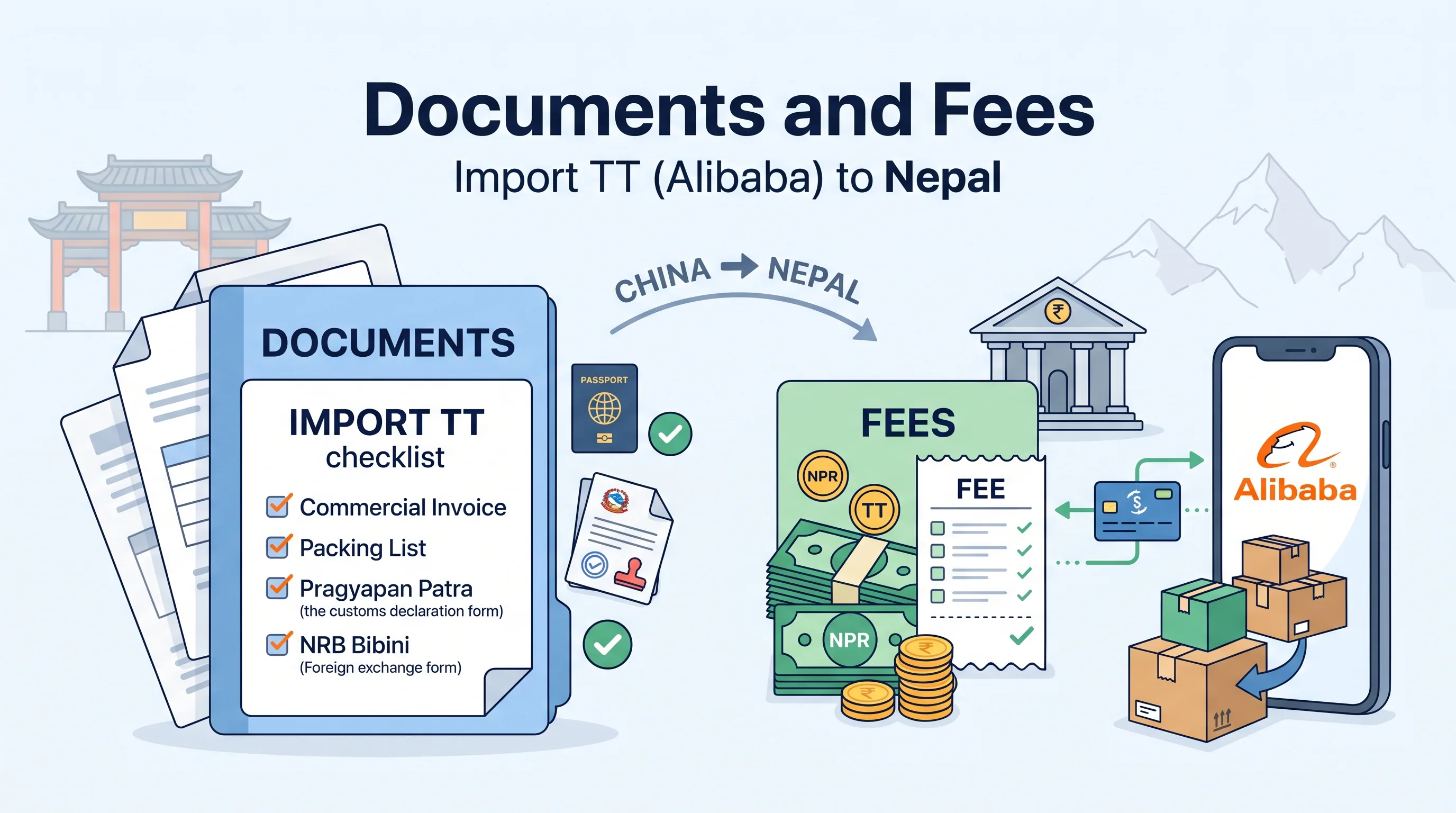
A complete breakdown of the required company documents and bank charges for an import TT from Nepal to China, based on direct experience with NIMB.
Quick Answer: To process an import Telegraphic Transfer (TT) from Nepal to China, Nepali banks require two sets of documents: Category I (bank-provided letter templates printed on your company letterhead) and Category II (your PAN, EXIM certificate, latest tax clearance, and company registration/MoA/AoA). For bank charges, expect a Rs. 1,750 flat fee per invoice, a 0.25% bank charge, a refundable 3% stack margin hold (if paying USD from an NPR account), and a variable Chinese bank processing fee of up to 15%.
Once your Chinese supplier issues a bank-compliant Proforma Invoice →, the next step is to visit your bank in Nepal to wire the payment via Telegraphic Transfer (TT). At this stage, your bank will ask for a laundry list of legal documents and charge specific transfer fees.
This guide covers Step 2 of our complete China-to-Nepal import series. For the full 10-step overview from sourcing to customs clearance, read our main guide: How to Import Goods from China/Alibaba to Nepal: The Bank TT Process, Step by Step (2026) →
A Quick Note on My (The Author's) Experience:
This blog is based on my (The Author's) direct, hands-on experience importing goods from China through Nepal Investment Mega Bank Limited (NIMB) in February 2026. Every document list, fee figure, and compliance rule below comes from what the bank asked of us. (Note: Banking fees and required documents can vary by bank or change over time, so always verify with your own bank branch).
TL;DR: The Two Categories of Documents Required by the Bank
Navigating the paperwork for your first import TT can feel overwhelming. To make it simple, I've divided everything your bank asks for alongside your Proforma Invoice falls into two categories:
Category I: Letters for which the bank provides templates (printed on your company letterhead).
Category II: Your official company registration and tax documents.
Document Category What it means Exact Documents Category I Letters for which the bank provides templates 1. Declaration of the Goods/Services imported under LC/DAP/DAA/Draft/TT 2. Declaration of Non-Shipment 3. Draft TT Exchange Service Application Form for Fund Transfer 4. TTF for Import Form Category II Your company documents 1. Company Registration Certificate 2. PAN Certificate 3. EXIM Certificate 4. Latest Tax Clearance Certificate 5. Memorandum of Association (MoA) 6. Articles of Association (AoA) and any other registration documents of the company - How to Prepare Category I Documents (Bank Letter Templates)
- You do not need to draft Category I letters from scratch. Contact your bank’s trade or TT department and ask them to email you the standard word templates. Once you receive them, fill in your transaction details, print them on your official Company Letterhead, and apply your physical company stamp and authorized signature.
- How to Prepare Category II Documents (Company Legal Papers)
- For Category II documents, any active business will already have its PAN Certificate and Latest Tax Clearance Certificate on hand. However, keep in mind that Company Registration documents, the Memorandum of Association (MoA), and the Articles of Association (AoA) are only required if your business is registered as a Private Limited or Public Limited company. Still, it is always best to double check with your bank branch, as the list above reflects the exact documents we were asked to submit.
- How to Get Your EXIM (Export-Import) Certificate
- Your EXIM Certificate is your official government permission to import and export goods in Nepal. You can apply for an EXIM code online through the Nepal Customs EXIM Portal. However, we strongly advise contacting the Customs Department directly before filling out the online form to make sure your paperwork and bank guarantee details match their latest requirements.
- The Major Compliance Check: Does Your PAN or MoA Allow Importing That Item?
- Before approving your TT, the bank will perform one major verification on your Category II documents: they will check whether your PAN or Company MoA explicitly mentions that your company is permitted to import the exact goods listed on your Proforma Invoice.
- For example, if you are importing "Good-A", your PAN or MoA must state that your business operations include importing "Good-A" (or its specific product category). If your MoA only mentions dealing in textiles, the bank will not allow you to wire money to import electronics or automobile parts. If the item category is not mentioned in your existing documents, you will first need to update your company objectives at the relevant government department to include importing those specific items.
- Upon updating, you will receive an official amendment document, which you must include in every banking step where company documentation is requested.
- Detailed Bank Fee Breakdown for Each Telegraphic Transfer (TT)
- When calculating your landed product cost, you need to factor in the banking fees on both the Nepali side and the Chinese side. Based on our TT payment through Nepal Investment Mega Bank Limited (NIMB), here is the exact fee breakdown per invoice:
Fee / Charge Type Amount / Percentage How It Works Flat TT Payment Fee Rs. 1,750 per invoice Charged by the Nepali bank for each Proforma Invoice payment processed. 3% Stack Margin Hold (Refundable) 3% of invoice amount Held by the bank if you pay in USD from an NPR bank account. Released back to your account after your package arrives and you submit your stamped Bibini(bi.bi.ni) to close the TT. (Not held if paying from a USD account). Additional Bank Charge 0.25% per invoice Standard percentage processing charge applied by the Nepali bank per invoice. China Bank Processing Fee Up to 15% (variable per bank) Charged by the Chinese receiving or intermediary bank to process the incoming wire. Must be clarified with your supplier beforehand.
- Understanding the 3% Stack Margin Hold
- If you are paying a USD Proforma Invoice using a standard NPR (Nepali Rupee) bank account, the bank will hold an extra 3% stack margin on top of your invoice value. Do not treat this as a permanent cost. Once your shipment clears customs, you inform the bank and submit your stamped Bibini and clearance receipts (within 90 days), and the bank releases that 3% held amount back into your bank account.
- If your company holds a USD bank account and pays directly from it, the bank will not hold this 3% margin.
- Who Pays the Up to 15% Chinese Bank Processing Fee?
- During our transaction, NIMB's TT handling officer informed us that the bank on China's end also takes a processing fee of up to 15% per invoice (the exact rate varies depending on the Chinese bank). Because of this, you must clarify with your supplier beforehand who is covering the Chinese bank's processing fee: you or the supplier? Remember the golden rule of Nepali import banking: A Nepali bank will only wire the exact Total Amount written on the Proforma Invoice, and will not send extra money for separate bank or delivery charges. We do not have confirmation on whether all banks require you to bake that fee into the per-item unit cost if the buyer pays it, so check with your bank branch if your supplier asks you to cover it. In our case, our supplier confirmed that we only needed to pay the exact amount mentioned on the Proforma Invoice, and they handled the Chinese bank processing fee on their end.
Next Step: Once your TT payment is wired and your goods ship, learn how to get your Bibini and clear customs in our next guide:
What Is a Bibini, and How Do You Clear Goods at TIA Customs? →
Use Your Import Documents to Get Verified and Sell Direct on Afno Site
Gathering your PAN, company registration, and tax clearance to wire an import TT takes real effort. And once that wire goes through, your shipment will take anywhere from a week to over a month to reach Nepal. You went through all this banking paperwork to cut out local wholesale middlemen and get the best possible unit margins directly from China. The last thing you should do once your products arrive is hand a percentage of every sale over to an e-commerce platform when you're just starting out, or spend all day replying to scattered messages across Instagram, TikTok, and Facebook.If you are importing products in any of the three categories that Afno Site serves (Clothing & Thrift, Jewellery & Crafts, or Cosmetics & Lifestyle), you can put your company documents to work right now by setting up your store on Afno Site while your goods are in transit:
- Get Your Verified Seller Badge Instantly: Since you already have your PAN and business registration scanned for the bank, submit them on Afno Site to earn a Verified Seller Badge on your storefront. Customers trust verified stores immediately.
- Remove E-Commerce Middlemen with a Fixed Monthly Cost: Afno Site charges a flat monthly fee with 0% commission, letting you keep 100% of every sale.
- One Bio Link for All Your Social Pages: Upload your incoming products from your phone and place your single store.afnosite.com link across Instagram, TikTok, and Facebook so you are ready to accept clean orders the moment your boxes arrive.
Frequently Asked Questions (FAQ)
How much does a Nepali bank charge for an import TT to China?
Based on our transaction with Nepal Investment Mega Bank Limited (NIMB) in February 2026, the bank charges a flat fee of Rs. 1,750 per invoice payment plus an additional 0.25% bank charge per invoice. If you pay in USD from an NPR account, the bank also holds a 3% stack margin, which is refunded once you clear the goods and close the TT file. Additionally, the Chinese bank may charge a variable processing fee of up to 15%.Do sole proprietors need a Memorandum of Association (MoA) for an import TT?
No. While every importer needs a PAN Certificate, EXIM Certificate, and Latest Tax Clearance Certificate, the Memorandum of Association (MoA) and Articles of Association (AoA) are only required for Private Limited and Public Limited companies. However, always confirm the exact document checklist with your bank branch.What happens if the product we want to import is not listed in our company MoA or PAN?
Your bank will check whether your PAN or Company MoA explicitly allows you to import the specific goods listed on your Proforma Invoice. If it is not mentioned, the bank will not process the TT until you officially update your company objectives at the government office and include that update document with your banking paperwork.Read more things that you need to consider before you import through Ali Baba from China →